What's New
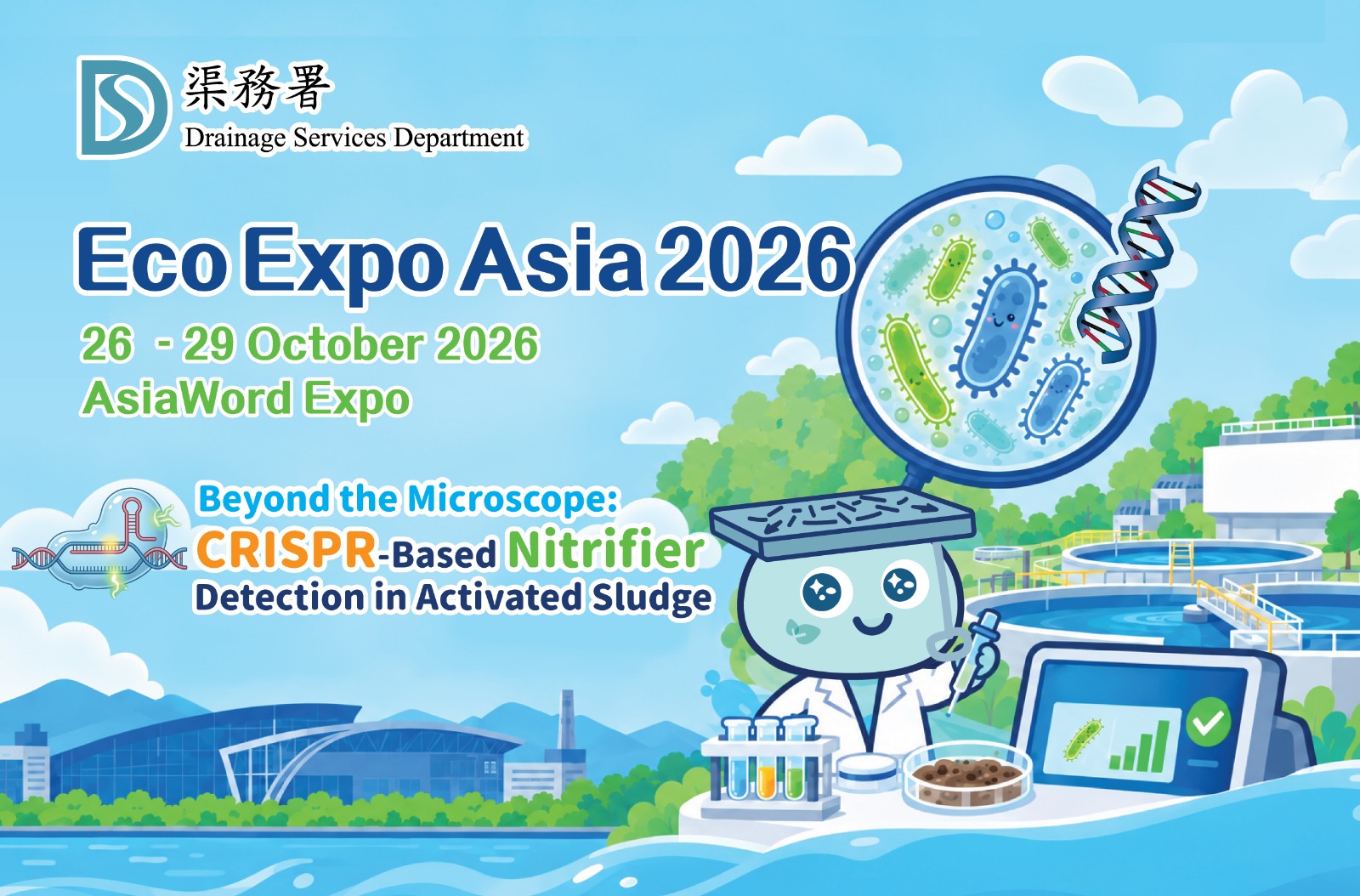
Eco Expo Asia 2026
9 October 2026
Eco Expo Asia 2026 returns to the AsiaWorld-Expo from 26 to 29 October 2026. The first three days will be open to the industry, while the final day will also welcome the general public. Under the theme "Connecting the World for a Sustainable Future", the Expo aims to promote innovative green solutions. As a premier annual event for the global environmental protection industry, it has long served as a professional platform for showcasing the latest green technologies and research findings, supporting Hong Kong's progress towards sustainability and its development as a liveable city.
At this year's Expo, the Drainage Services Department (DSD) will introduce the following innovative technology:
Beyond the Microscope: CRISPR-Based Nitrifier Detection in Activated Sludge
The activated sludge process is a biological treatment method widely used in sewage treatment. It involves aerating wastewater mixed with a concentrated suspension of microorganisms (the "activated sludge"). These microbes consume and break down organic pollutants, converting them into carbon dioxide, water, and more microbial biomass. The treated effluent is then separated from the sludge, with a portion recycled to maintain the microbial population.
Monitoring the microbial community is essential, as the entire process depends on a healthy and balanced microbial population. Changes in microbial activity, composition, or health can indicate the presence of toxic substances in the wastewater, nutrient imbalances, or inadequate treatment performance. Regular microscopic examination and monitoring help operators maintain stable operations and good effluent quality.
At this Expo, the DSD will introduce a CRISPR-based molecular method for detecting and quantifying nitrifying bacteria in activated sludge, together with its applications in sewage treatment. The approach relies on the design of specific guide RNAs (gRNAs) that precisely target conserved DNA sequences unique to nitrifiers (e.g., key functional genes involved in ammonia or nitrite oxidation). Upon recognition of the target DNA, a Cas nuclease is activated and performs collateral cleavage of fluorescent reporter molecules. The resulting fluorescent signal intensity is proportional to the abundance of the target gene, thereby providing a quantitative measure of nitrifier populations in the sludge.
This molecular approach offers significant advantages over traditional microscopy-based methods. With its portability and rapid detection capability, this technology enables operators to optimise the sewage treatment process more efficiently, offering a powerful new solution for the monitoring and management of sewage treatment facilities.