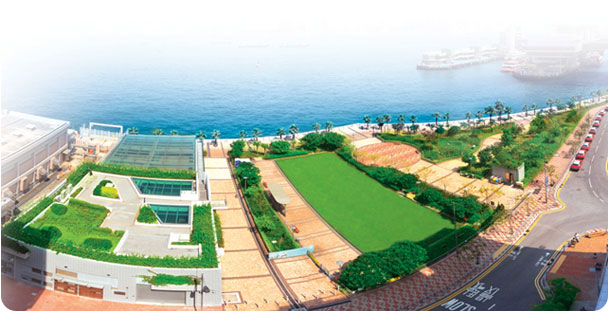
Flood Prevention
Protecting the general public against flooding is the
Department’s main concern; thus our all-out efforts
to ensure our drainage systems remain first-class and
up-to-date. |
|||||
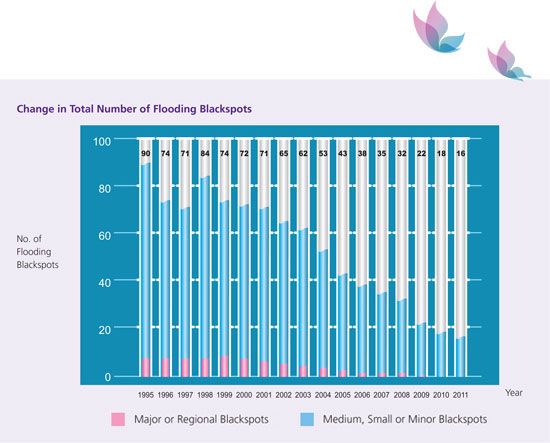
| Overview During the past year, the Department has continued its efforts to improve drainage systems, step up flood prevention measures, review and update Drainage Master Plans (DMPs), and come up with strategies to cope with the city’s changing drainage needs. In urban areas, a series of improvement works totalling $9.6 billion that cover the construction of drainage tunnels in Hong Kong West, Tsuen Wan and Lai Chi Kok, are well under way. These tunnels, when completed, will intercept stormwater from the mountains and raise the flooding prevention level of Tsuen Wan, West Kowloon and the northern Hong Kong Island. Elsewhere in Wong Tai Sin, the improvement works of Kai Tak River has been commenced in phases since 2010. In the New Territories, another $12.8 billion programme of flood prevention works, launched since 1997, is in progress. Such works include the training of rivers of more than 100 kilometres and flood protection schemes in 27 villages. (Details of the major flood control projects are listed in Appendix A and their locations in Appendix B.) Bold new initiatives marked the year too: an underground stormwater storage scheme in Happy Valley, the second for Hong Kong, is now in the design stage; comprehensive reviews of the decade-old Drainage Master Plans for West Kowloon and for East Kowloon are to begin by the end of 2011; and drainage improvement measures for seven catchments within Yuen Long and the Northern District, are being formulated. Prevention is better than cure. In maintenance and operation during 2010-11, our staff carried out regular preventive work, such as inspection, desilting and maintenance, which covered more than 2273 kilometres of drains and watercourses, costing some $112 million. (Details are shown in Appendix C.) Our endeavour to improve drainage, coupled with the completion of various projects, resulted in the removal of all remaining major flooding blackspots. Remaining now are 16 blackspots of less severity. We are closely monitoring these locations during rainy days and expect to clear them all when we complete other improvement projects. |
|||||
 |
|||||
 |
|||||
| All in all, 2010-11 remained a smooth and productive year. The year’s weather, however, was unpredictable — characterised by irregular temperatures and rainfall. In July 2010, Hong Kong was hit by two severe storms necessitating the issues of Black Rainstorm Warning Signal by the Hong Kong Observatory. The flooding that induced by the rainstorm on 22 July cost the life of one villager and damaged considerable property each at Sha Po Tsai Village in Tai Po and Ying Pun Village in Sheung Shui. The unfortunate incidents reminded us of the need to complete the on-going improvement works at Upper Tai Po River and Ying Pun River soonest possible. On the other hand, we collaborated with the Hong Kong Observatory and the Home Affairs Department to initiate a Regional Rainfall Warning System and to provide a temporary shelter for Sha Po Tsai villagers, until the improvement works are completed. In 2010, the Amber, Red and Black Rainstorm Warning Signals were issued 17, 7 and 2 times respectively. Although the first six months of 2010 was relatively dry with a total rainfall 16 per cent below normal, we had a record-breaking daily rainfall of 94.1 millimetres for February. Together with the passage of two tropical cyclones in September, the total rainfall recorded for the year was 2371.7 millimetres, comparable to the normal annual figure. |
|||||
 |
|||||
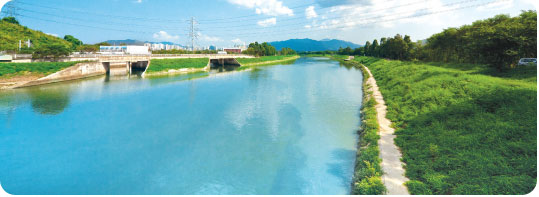
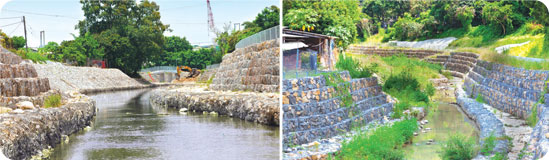
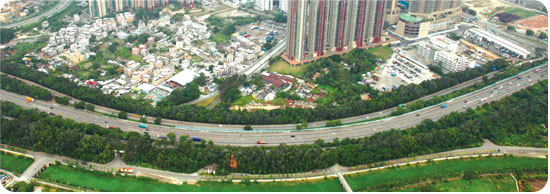
| Flood Prevention in the New Territories Low-lying topography, insufficient drainage facilities and rapid urban development in the New Territories have always been the main considerations for our Department in mapping out flood prevention strategies. Since the late 1990s, our Department has constructed about 79 kilometres of drainage channels to better collect and convey stormwater. Village Flood Protection Schemes, to protect some 30000 villagers, have covered 35 villages in 240 hectares of low-lying areas. We will continue our efforts in implementing flood protection projects. In the northern New Territories, our Department is carrying out detailed design on regulating the upstream section of Shenzhen River, from Ping Yuen River to Pak Fu Shan, so as to meet the recent development needs of the Liantang-Heung Yuen Wai Boundary Control Point. This project is scheduled to commence in 2013 for completion in 2017. |
|||||
 |
|||||
| In the northwest New Territories, that is Tin Shui Wai, Yuen Long and Kam Tin, flooding occurrences have been greatly reduced as a result of our river training works. Some of the major projects already completed are the drainage channels at Kam Tin River, Tin Shui Wai River, Ngau Tam Mei River, San Tin Eastern River and the Yuen Long Bypass Floodway. To enhance flood protection levels at seven catchments, identified in our review study for the DMPs on Yuen Long and the northern New Territories commissioned in 2008. This review came about due to a need to re-assess and update the DMPs on Yuen Long and the northern New Territories, completed in 1998 and 1999 respectively. The seven catchments within the review study area are Yuen Long , Tin Shui Wai, Lau Fau Shan, San Tin, Sheung Shui, Ta Kwu Ling and Sha Tau Kok. We are currently formulating the flood protection schemes and will finalise them after consulting the relevant Government departments, green groups and the public. The review study would be completed in late 2011. Elsewhere in the New Territories, such as Tai Po, caught our attention with its inadequate drainage system and low-lying topography. Projects to improve the drainage systems in Tai Po’s Lam Tsuen River and Tung Tze Road are progressing well under our close supervision. |
|||||
 |
|||||
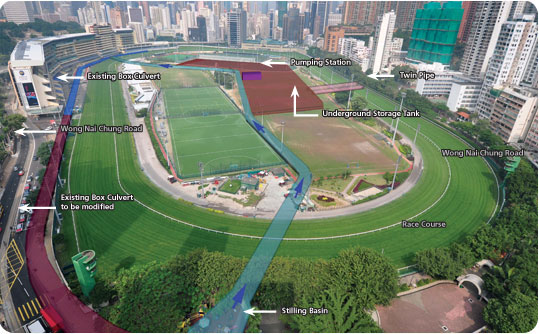
| Flood Prevention in Urban Areas Urban areas necessitate different flood prevention approaches due to a much higher population density. We devise stormwater storage schemes, pumping stations and flow diversion through drainage tunnels to minimise the extent of works that may disrupt traffic. On the Hong Kong Island, we have decided on an underground stormwater storage scheme underneath the Happy Valley Recreation Ground to relieve flooding at Wong Nai Chung Road, Tin Lok Lane, Lap Tak Lane and Morrison Hill Road areas. The project is now in the design stage. To reduce the flood risk in the northern part of the Island, works on the Hong Kong West Drainage Tunnel are going ahead as planned. In January 2011, excavations of this 11-kilometre long tunnel were completed while adit works by drill-and-blast are in progress. Upon completion in 2012-13, the tunnel will intercept stormwater from the upper catchment at mid-levels from Tai Hang to Kennedy Town and discharge it to the sea near Cyberport — thus reducing the volume of rainwater flowing to downstream areas including Sheung Wan, Central, Admiralty and Wan Chai. In Kowloon, apart from the improvement works to Kai Tak River in Wong Tai Sin, we are constructing drainage tunnels in Lai Chi Kok and in Tsuen Wan. The Lai Chi Kok Drainage Tunnel, measuring 4.9 metres in diameter and 3.7 kilometres in length, will cost around $1.7 billion. A state-of-the-art slurry shield tunnel boring machine is being used for its construction. Boring for the branch tunnel was completed in January 2011; for the main tunnel, it will be end of 2011. The entire project will be completed in 2012 to alleviate flooding risk in Lai Chi Kok, Cheung Sha Wan and Shum Shui Po areas. The Tsuen Wan Drainage Tunnel, of 5.1-kilometre long, 6.5-metre in diameter, costing $1.3 billion, is progressing well. It will relieve flood risk in both Tsuen Wan and Kwai Chung when it becomes operational in 2012-13. |
|||||
 |
|||||
|
|||||
 |
|||||
|
|||||
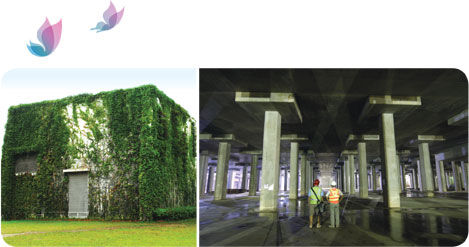
| Bold New Initiatives Happy Valley Underground Stormwater Storage Scheme The underground stormwater storage scheme, planned for the recreation ground inside the Happy Valley racecourse, will follow an innovative and practical approach for flood prevention. It will be the second such scheme in Hong Kong; the first is in Tai Hang Tung, completed in 2004 to address flooding problems in Mong Kok. Under the Happy Valley scheme, an underground storage tank with a capacity of 60000m3 will be built with pumping facilities and a box culvert. This Scheme is currently in the design stage. Construction will start in mid-2012 and be completed in early 2018. It will be carried out in two phases; the first will be for half of the storage tank, pump house and diversion box culvert. By early 2015, we hope to commission the first phase of the Scheme. |
|||||
 |
|||||
|
|||||
|
|||||