| DSD commits to incorporating environmental design in drainage infrastructure. Recognizing the aspirations of the public for green buildings to enhance quality of life and to help protect the environment, DSD places great emphasis on the greening of sewage treatment works, sewage or floodwater pumping facilities, and drainage channels. | ||||||||
| DSD’s facilities are now getting visually sensitive to their neighbours when urban areas are being extended to meet the demand for housing. While landscape design is introduced to every new works, DSD is also pursuing more landscaping measures in existing facilities when opportunities arise. This chapter presents our recent works on green roof, vertical greening, and green channel to illustrate how environmental design is practised in drainage projects. | ||||||||
Green Roof in Pumping Station |
||||||||
Green roof increases aesthetic value, contributes to environmental qualities and enhances energy performance of buildings. There are two types of green roofs, namely ‘Intensive Green Roof’ which is also known as roof garden; and ‘Extensive Green Roof’ which is also known as eco-roofs. Intensive green roofs are characterised by their use as a ‘garden’ in much the same way as people would use a garden at ground level. Extensive green roofs, on the other hand, are better-suited to retro-fitting projects which have their own technical, management and maintenance constraints. For new structures or developments, a minimum of 300mm soil depth should be allowed in order to create a better physical condition for planting. In upgrading existing roofs to green roofs, we need to check a number of conditions and make some modifications for providing a minimal soil depth of about 150mm for planting as follows: |
||||||||
|
||||||||
 |
||||||||
| By the end of 2009, DSD has already provided more than 1,200 m2 of green roofs in our facilities, and another 6,000 m2 green roofs would be completed in 2010. | ||||||||
Vertical Greening at Shatin STW |
||||||||
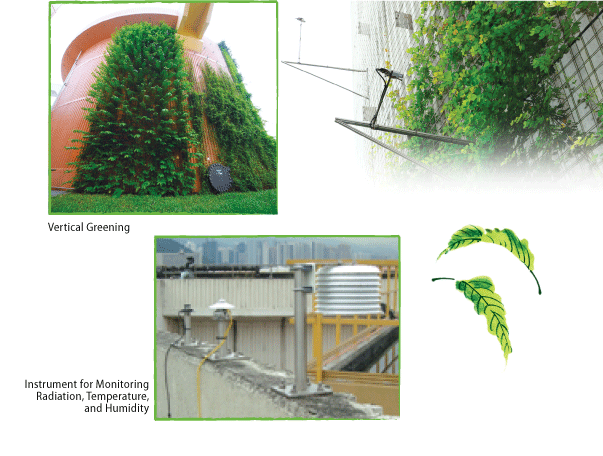
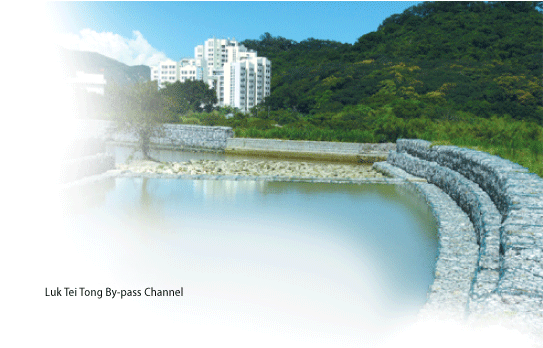
| With successful experience on greening of rooftops, DSD attempts to introduce vertical greening on the side walls of drainage structures. Four huge circular sludge holding tanks at Shatin STW were selected for conducting a pilot scale study in collaboration with a local tertiary institution. These tanks are rather harsh in appearance and they do not absorb much solar heat. However, they provide perfect surfaces to explore the feasibility of establishing a living vegetation cover and to ameliorate the visual and microclimatic condition of the site as a whole. | ||||||||
Objectives of the study: |
||||||||
|
||||||||
| The tanks are erected in a square pattern, contributing to a total 4,500 m2 of wall surface area. Each tank is demarcated into four quarters based on the four cardinal compass orientations of east, south, west and north. Each quarter is further divided into four sectors to receive four different experimental treatments. There are a total of 64 sectors in the trial, and each sector is denoted as an experimental plot with a surface area of 70 m2. | ||||||||
 |
||||||||
| There are two major experiments in this study. The first one is to investigate the site factor effect on vertical greening. Based on analysis of the site conditions and practical considerations, three principal factors are included in the experiment. They are orientation, the way the plant species attached to wall surface, and soil characteristics. The second one is to study the growth and performance of 16 different climber species for vertical greening in Hong Kong. The whole study will be completed by the end of 2011, and the findings of the study will provide useful information for evaluating alternatives to enhance vertical greening in DSD’s facilities. | ||||||||
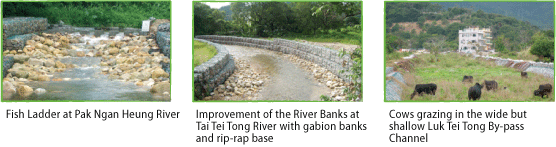
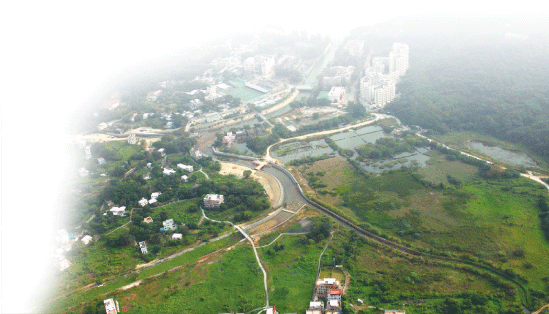
| Ecological Enhancement of the Drainage Improvement in Mui Wo This case shows how ecological features are considered and incorporated in a box culvert and a by-pass drainage channel in Pak Ngan Heung and Luk Tei Tong when natural channels are widened to alleviate flooding risks of the low-lying areas in Mui Wo. |
||||||||
 |
||||||||
At the upstream end of Pak Ngan Heung River, there was a weir for agricultural purpose. A shallow pond of water at the upstream of the weir provides a habitat for aquatic life. After widening the river, the weir was reconstructed to re-provide an ecological habitat. In addition, we took this opportunity to enhance the ecology of the river by providing a fish ladder at the downstream end of the weir to facilitate the movement of fishes and other aquatic organisms across the weir. The fish ladder consists of several steps of pools and small falls formed from randomly placed boulders and cobbles. This irregular arrangement mimics a natural stream course and provides habitats for aquatic life. At Luk Tei Tong, a shallow but wide by-pass channel was constructed to mimic the original native marshland features. In order to restore the ecology of the area, the original top soil together with the seeds and roots of the native plant species were removed before commencement of construction and stored for reuse subsequently as top soil along the channel bed. As a result, the original marshland plant species have re-established successfully in the area. To promote greening of the channels, DSD also carries out extensive planting of trees and vegetation along river banks. In this project, most of trees are native species in Mui Wo, and a conservation approach was adopted in the design of the landscape works. |
||||||||
 |
||||||||