| The Sewage Services Charging Scheme, introduced in April 1995 according to the “polluters pay” principle, requires a discharger to pay for the cost of sewage services provided in accordance with the quantity and pollution strength of the wastewater discharged. |
Let’s Contribute All premises connected to public sewers are required to pay the sewage services charges. Sewage services charges have two components: the Sewage Charge (SC) and the Trade Effluent Surcharge (TES). The SC aims at recovering the cost of collecting and treating wastewater at or below domestic strength. The TES aims at recovering the additional cost of treating trade effluent with pollution strength exceeding that of the domestic sewage. Since the implementation of the charging scheme, many new sewerage infrastructures were commissioned and put into service. In addition, several sewerage projects under planning will be completed in the coming years. Consequently, the operation and maintenance costs have been increased substantially. Adjustment of sewage services charges is therefore required to provide better sewage services. With effect from 1 April 2008, the SC rate has been increasing by 9.3% annually, up to $2.92 per cubic metre in 2017. The TES rates have been adjusted since 1 August 2008. Three trades were no longer required to pay TES; rates for 13 trades were reduced whereas rates for 14 trades were increased (among them, rates for 13 trades had been increased in two increments with the second one on 1.8.2009). In addition to the charging scheme, we hope that through education and promotion, cooperation with environment organizations and consultants, to further promote the public awareness of environmental protection. We have to treasure our environment and use its resources more rationally, so as to facilitate the sustainable development in Hong Kong. Customer Enquiries |
|
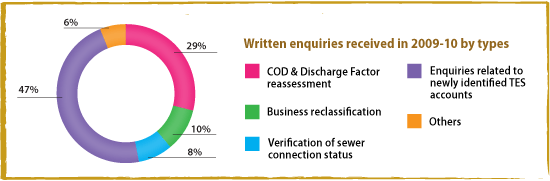
| The following chart presents a breakdown by types of written enquiries received in 2009-10. In this year, we continued to achieve the provision of a full reply to customers within one month from the date of receipt of a written enquiry for more than 98 per cent of the cases, meeting our performance pledge. |
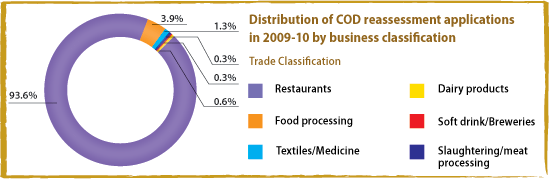
Reassessment of TES Rate and Discharge Factor The number of applications for reassessment of the TES rate and the discharge factor in 2009-10 were 311 and 30 respectively. The number of cases approved for reassessment of TES rate and discharge factor in 2009-10 were 126 and 18 respectively. The distribution of applications for reassessment of TES rate (COD reassessment) in 2009-10 by business classification is shown in the following chart. |
 |
Business Reclassification |
| Billing and Consumption Statistics There are about 2.75 million water accounts of which about 2.55 million are liable to pay sewage charge. |
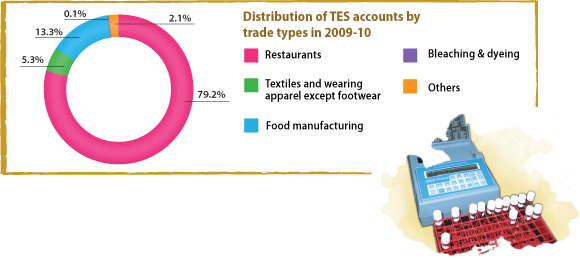 |
| In the non-domestic category, about 19,800 accounts are liable to pay TES as they are operating one of the 27 trades designated in the Sewage Services (TES) Regulation. The distribution of TES accounts by trade types is shown in the following chart. |
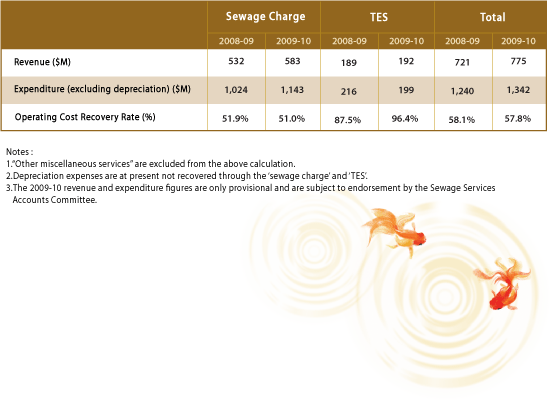
| Revenue and Expenditure The revenue and expenditure in the Sewage Services Operating Accounts for the past five years are summarized in the Table below: |
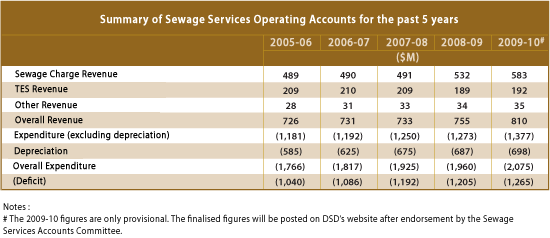 |
The total revenue from sewage charge and TES for 2009-10 was higher than the year 2008-09. The net increase of $54 million on overall sewage services revenue was mainly due to the increase in sewage charge rate from $1.31 to $1.43 per cubic metre with effect from 1 April 2009. As compared with 2008-09, the overall expenditure excluding depreciation increased by $104 million and the depreciation increased by $11 million mainly due to increase in operating expenses and commissioning of new facilities. As a result, the deficit of sewage services for 2009-10 was $1,265 million which was $60 million higher than that of 2008-09. |
 |