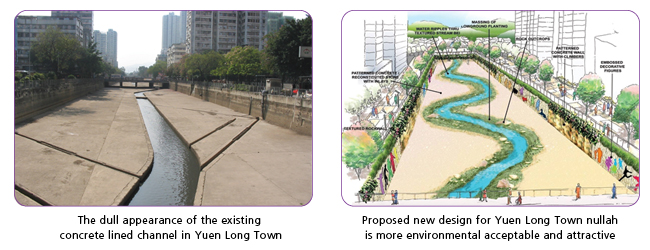
Overview Since 1997 DSD has been implementing a $11.8 billion flood prevention programme in the NT, including more than 100 km river training works and 27 village flood pumping schemes. In the urban areas, a $8.8 billion programme of drainage improvement works to raise the flood protection level in the concerned catchment including the construction of Hong Kong West, Tsuen Wan and Lai Chi Kok drainage tunnels which are now progressing in good speed. Besides continuing with the implementation of planned flood protection projects, DSD is actively reviewing new flood protection needs. The Drainage Master Plan (DMP) Studies for Yuen Long and the Northern NT (NNT) were completed in 1998 and 1999 respectively. The majority of the improvement works and river training works recommended in the Studies have been completed. However, in view of changes in land uses and new developments planned within the areas, DSD commissioned a DMP Review for Yuen Long and North Districts in March 2008. Taking account of the major changes in land uses, new development proposals and town planning, numerical models for evaluating the hydraulic performance of the major rivers/channels are being set up. Further drainage improvement works for major rivers, upstream channels and the local flooding spots would be proposed by the Study which is expected to be finalized in late 2010. Apart from incorporating green features in drainage works, DSD also makes efforts to beautify existing drainage channels. DSD is planning to improve the appearance of the existing nullahs in Yuen Long Town and enhance their surrounding environments. These nullahs have concrete lining and were constructed more than 40 years ago. DSD has commissioned a consultancy study to examine options and proposals to improve the drainage and environmental conditions. Following public consultation including the concerned green groups and district councillors, the feasibility study and the preliminary design of the improvement of the Yuen Long nullahs have been completed in mid 2009. In respect of operation and maintenance, DSD continues to carry out preventive measures including inspection, desilting and repair works for drainage systems. In 2008-09, over 1,600 km drains and watercourses were inspected and about $109 million was spent on such maintenance works. DSD always puts efforts in resolving issues related to problematic road gullies, stormwater intakes, drains and watercourses and inspects them on a regular basis especially before and during the rainy season. |
|||||
|
|||||
|
|||||
Flooding Incidents in 2008 The weather of June 2008 was marked by heavy rain and squally thunderstorms. The monthly total rainfall was 1,346 mm, and at 8 to 9 a.m. of 7 June the hourly rainfall was 145.5 mm, which were the new highest monthly and hourly rainfall records at Hong Kong Observatory respectively. On 7 June, DSD received more than 600 nos. of flood cases in various locations due to prolonged and heavy rain. The relatively more serious cases include the ones at Wing Lok Street in Sheung Wan, Des Voeux Central in Central, Morrison Hill Road/ Wong Nai Chung Road in Wan Chai and those caused by landslide at North Lantau Highway. The Tai Hang Tung Storage Tank functioned effectively as designed during the heavy rain. Excess runoff which could not be discharged properly via the underground drains into the sea was temporarily stored in this 100,000 m3 storage tank. It had prevented extensive and serious flooding along Nathan Road in Mong Kok area. |
|||||
|
|||||
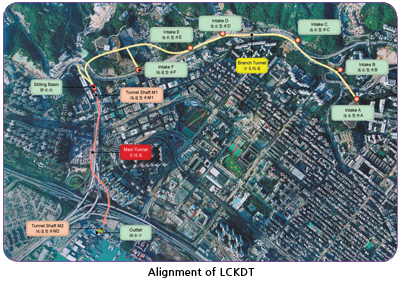
Flood Prevention in NT Flood Prevention in NNT and NWNT NNT NWNT Flood Prevention in Urban Areas West Kowloon To address the flooding problems in Lai Chi Kok, DSD is constructing the Lai Chi Kok Drainage Tunnel (LCKDT) at a total cost of $1.7 billion. The works commenced in late 2008 for completion in 2012. The LCKDT is 3.7 km long with 4.9 m internal diameter running from south of Chak On Estate via the former Wai Man Tsuen to Victoria Harbour. Six stormwater intakes will be built along the upstream section of the drainage tunnel to intercept stormwater surface runoff on the adjacent hillside. The tunnel will be constructed by a state-of-the-art slurry shield Tunnel Boring Machine (TBM) to be designed and supplied by a German TBM supplier. Design of the TBM is underway and is scheduled for delivering to the site in early 2010. |
|||||
|
|||||
|
|||||
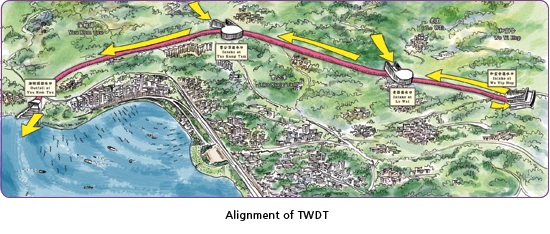
| Tsuen Wan DSD is also implementing Tsuen Wan Drainage Tunnel (TWDT) to relieve the flood risk in Tsuen Wan and Kwai Chung areas. This project consists of a 5.1 km long drainage tunnel with an internal diameter of 6.5 m, three intakes at Wo Yip Hop, Lo Wai and Tso Kung Tam respectively, an outfall at Yau Kom Tau and the associated greening works. The main tunnel would be constructed by a double-shield TBM with which tunnel linings could be installed shortly after tunnel boring. It prevents excessive loss of ground water and minimises the associated ground settlement problem. The TWDT project costs around $1.1 billion and commenced in late 2007 for completion in 2011-12. |
|||||
|
|||||
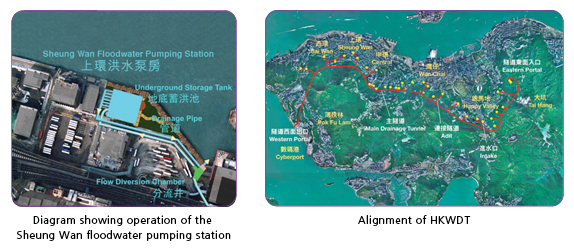
Hong Kong Island HKWDT is our major initiative to enhance the flooding protection in Northern Hong Kong Island. Upon project completion, the 11 km long new tunnel will intercept stormwater from the upper catchment at the mid-levels from Tai Hang to Kennedy Town and discharge it to sea near Cyberport, thus reducing the volume of rainwater flowing to the downstream low-lying areas including Sheung Wan, Central, Admiralty and Wan Chai. This tunnel project also includes 34 intakes located in Mid-level and 8 km long connection adits. The design-and-build contract commenced in late 2007 for completion in 2012-13. The drainage tunnel will be constructed by two TBMs from the east and west sides of the tunnel. The TBMs of 7 m and 8 m diameter have been put into operation in early 2009. Construction of intakes will proceed in phases. The advance ground investigation and utility identification works are near completion. The intake construction works, comprising intake structure, drop shaft and adit, at Stubbs Road and Smithfield have commenced. |
|||||
|
|||||
|
|||||
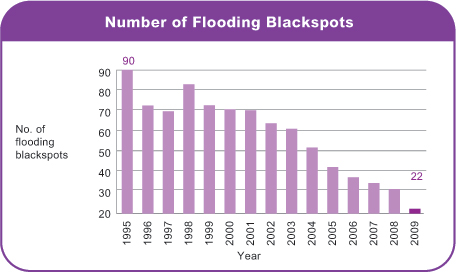
| Reducing Flooding Blackspots Since 1995, DSD has identified more than 130 flooding blackspots. With the implementation of various major drainage projects, we removed 109 flooding blackspots in both urban and rural areas. Last year, we successfully removed 11 flooding blackspots. Currently there are 22 flooding blackspots and most of them will be relieved by drainage improvement works being implemented. We are closely monitoring these locations during heavy rainstorms and expect the majority of these blackspots to be removed after the completion of the drainage improvement works. |
|||||
 |
|||||
 |
|||||
|
|||||