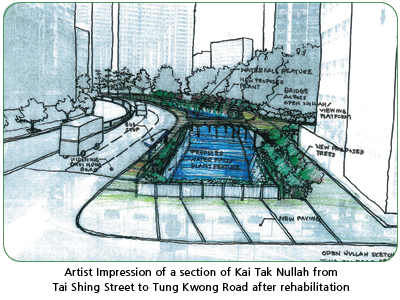
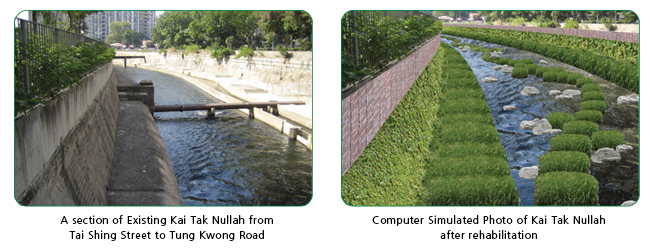
Sustainable drainage design continues to draw increasing public interest. DSD therefore pays special attention to consult District Councils, the green groups and other stakeholders at the early stage of planning work. The experience of such practice suggests that early consultation is very useful. It provides engineers with ample opportunities to understand the views, though sometimes contradictory, of the stakeholders. These views are valuable information for designing the drainage infrastructure that meets both ends of effective flood prevention and protection of the environment. This chapter presents four cases of environmental design; they are the greening of Kai Tak nullah, the ecological enhancement of Ho Chung river improvement works, the landscaping of the Sheung Wan stormwater pumping station, and the landscape works at Shatin STW. Greening of Kai Tak Nullah Recognizing the pubic demand for revitalizing the Kai Tai Nullah, DSD has directed the consultants of this project to include the greening the Kai Tak nullah as an alternative of decking the nullah. Following extensive consultation with stakeholders, the consultants recommend the revitalization of a section of Kai Tak nullah between Tai Shing Street and Prince Edward Road East and aim to turn it into a “green” river. The initial environmentally friendly design includes the use of rubbles and cellular concrete grassing slab for the lining of the channel and the installation of floating units with planting. As the proposed greening section of nullah is in the tidal zone, studies are being conducted on the impact of saline water on the greening work. The goal is to revitalize the nullah to be a beautiful and vibrant water body that prevents flooding in a more natural setting. |
|||||
|
|||||
|
|||||
|
|||||
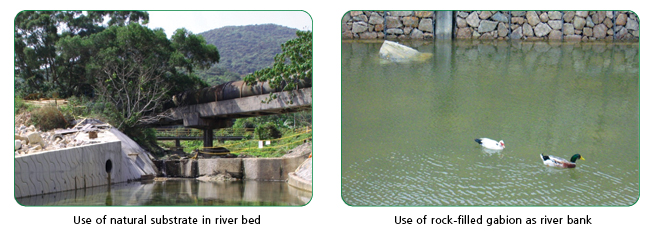
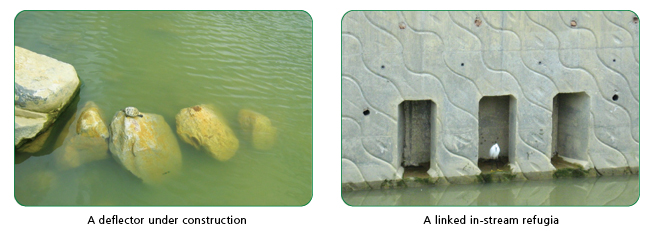
Ecological Enhancement of Ho Chung River Improvement Works For instance, the river bank is formed by rock-filled gabion fitted with planter pots to help re-establish riparian vegetation whenever there is enough room to avoid the use of concrete bank wall. When the concrete bank wall is unavoidable, in-stream refugia, the recesses purposely designed for and built into the wall surface, are created to increase habitat complexity. The refugia also serve the function of providing refuges for fishes, invertebrates and other aquatic animals during times of high flow. They are either isolated or interlinked inside the wall. Deflectors are installed along the widened river bank to vary the direction, depth and velocity of water flow, thereby forming zones of shallow water with reduced flow. Colonization of these areas by aquatic or riparian plants will increase the biodiversity of the river. A fish ladder consisting of ripples and pools formed from randomly arranged boulders and cobbles is added to allow the passage of fish and migratory invertebrates, such as the mitten crab Eriocheir japonicus, across a fung shui weir. Together with the irregular flow, the ecological features simulate natural stream flow environment and promote biodiversity in the man-made drainage channel which has a primary role to reduce the risk of flooding. |
|||||
|
|||||
|
|||||
|
|||||
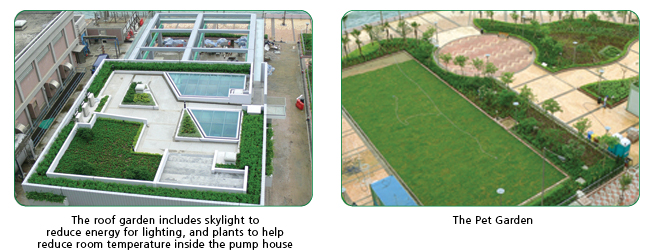
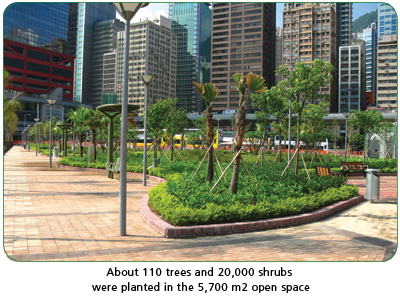
| Landscaping of Sheung Wan Stormwater Pumping Station The Sheung Wan stormwater pumping station is a new flood storage and pumping station for reducing the risk of flooding in the low-lying area in the vicinity of Wing Lok Street, Sheung Wan. During the design stage of the project, DSD made efforts to minimise the extent of above ground structures and explored the opportunities for landscaping. With the engagement of stakeholders, the project team has decided to use the roof of the pump house for a roof garden, to put a Tai Chi garden with pebble path for foot massage and a pet garden above the underground flood storage tank to turn the waterfront into a promenade, and to green the remaining open space with different trees and shrubs. |
|||||
|
|||||
|
|||||
|
|||||
Landscape Beautification Works at Shatin STW To enhance the greening and landscaping values of Shatin STW, we have started planting 1,700 trees and 420,000 shrubs in November 2008. After completion of the landscaping works, the working environment of Shatin STW will be greatly improved. The place will also become a new green oasis in Shatin District. Besides, vegetation can help in consumption of carbon dioxide emissions, mitigation in urban heat island effects and purification of air, and hence to improve the surrounding environment. As such, visitors, local residents and our staff can not only enjoy the environment of colourful scenery, but also have a fresh, beautiful and comfortable living environment. |
|||||
|
|||||