| Overview | ||||||||||||||||||||||||||||||||||||||
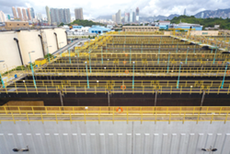
At present, 93 per cent of the population is served by public sewers which collect about 2.63 million m3 of sewage every day. About 70 per cent of the collected sewage receives chemical or higher levels of treatment before being discharged. To enable us to continue the efficient operation and maintenance of our existing facilities for sewage collection, treatment and disposal, we need to upgrade those facilities and build new ones. Our sewerage infrastructure has been significantly and continuously improved under a territory-wide programme for construction of new facilities and upgrade of existing ones, which includes 16 Sewerage Master Plans (SMPs) covering the whole territory and the Harbour Area Treatment Scheme (HATS) collecting screened sewage from both sides of Victoria Harbour for further treatment. HATS is a major sewerage infrastructure in Hong Kong. The commissioning of HATS Stage 1 in December 2001, providing treatment to about 75 per cent of the sewage from urban areas around the Victoria Harbour, has brought significant improvement to water quality of the eastern and central part of our harbour. Disinfection facilities have also been constructed since April 2008 at the Stonecutters Island Sewage Treatment Works (STW) for completion in 2009. The remaining 25 per cent of sewage will be properly treated with further improvement to the water quality in Victoria Harbour after the commissioning of HATS Stage 2A in 2014-15. Apart from the facilities serving the Victoria Harbour under HATS, other major environmental improvement facilities include the Sha Tin STW Stage 3 remaining works and the effluent reuse pilot plant in Shek Wu Hui STW. Furthermore, there are several works on sewage collection and plant expansion being carried out, including the upgrading of Tai Po and Shek Wu Hui STWs. |
||||||||||||||||||||||||||||||||||||||
Sewage Treatment and Sewerage System We are currently operating 272 sewage treatment facilities including 66 sewage treatment plants and 206 sewage pumping stations. Out of the 2.63 million m3 sewage treated in a day, 30 per cent receives preliminary treatment, 53 per cent receives chemically-enhanced primary treatment (CEPT) and the remaining 17 per cent receives secondary treatment. The daily quantity of sludge treated and disposed of at the landfills is about 789 tonnes. We are also maintaining a sewerage network of over 1 500 km. As sewers are susceptible to blockage by grease and solids in the sewage, we have implemented a preventive maintenance programme to ensure the sewers are functioning properly. Last year, over 10 854 numbers of blocked drains were cleared and a total volume of around 3 048 m3 of silt was removed from the sewers. |
||||||||||||||||||||||||||||||||||||||
Progress in 2007-08 The HATS Stage 2 will be implemented in two phases to further improve the water quality of Victoria Harbour. Under the first phase (HATS Stage 2A), sewage from the remaining parts of Hong Kong Island will be collected by deep tunnels to the Stonecutters Island STW. The STW will also be expanded to provide chemically-enhanced primary treatment for all sewage from the whole HATS catchment. The phase will be completed in 2014-15. Under the second phase (HATS Stage 2B), new biological treatment facilities will be provided, but their implementation programme will depend on the review in 2010-11. In 2007-08, we continued our efforts to implement the HATS Stage 2A works at full speed. We have completed the environmental impact assessment (EIA) for the whole Stage 2A scheme and are seeking approval from the Director of Environmental Protection on the EIA report under the Environmental Impact Assessment Ordinance. On the investigation and design of the deep tunnel sewage conveyance system, we have undertaken an extensive ground investigation programme for collection of geological information for the design of the conveyance system. It included the first time use of state-of-the-art directional coring technique in Hong Kong to obtain detailed geological information along some 5 km of the proposed tunnel routes at strata located over 150 m below ground and under the harbour. One of the coring reached a length of over 1.2 km which is a new record. At the same time, the design of the conveyance system is progressing steadily and we aim to start the tunnel construction in 2009.
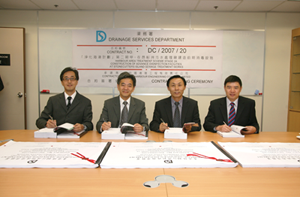
In August 2007, we awarded another consultancy contract to carry out the investigation and design services for the upgrading of the Stonecutters Island STW and the preliminary treatment works. This was the last consultancy package for the planning and design of HATS Stage 2A. With its commencement, the consultants are working closely together to dovetail the different components of the works with another in a timely manner to produce an integrated and cost-effective design for the whole Stage 2A scheme. We also awarded the first construction contract under HATS Stage 2A for the construction of disinfection facilities at Stonecutters Island STW. The works commenced in April 2008 for completion in October 2009. The contract comprises the construction of disinfection facilities at Stonecutters Island STW which will bring significant water quality improvement to the Tsuen Wan beaches by disinfecting the treated effluent to reduce the E. coli level in the treated effluent discharged. In parallel, we are constructing new sewers in the Sham Tseng area to improve the local sewerage networks and to intercept flows from unsewered areas which are also causing pollution to the Tsuen Wan beaches. The completion of the disinfection facilities at the STW and the local sewerage improvement works would facilitate the re-opening of the affected Tsuen Wan beaches at the earliest opportunity. As for the Stage 2A main works, construction is planned to start in 2009 and the whole of Stage 2A is targeted for commissioning by 2014-15, bringing about further long term improvements to the water quality of Victoria Harbour.
|
||||||||||||||||||||||||||||||||||||||
Public Private Partnership (PPP) PPP is an initiative in the Government to increase private sector involvement in the delivery of public services, and to br ing together the expertise of the Government and the private sector to better meet the needs of the public. To put this initiative into action, DSD has decided to adopt the Design-Build-Operate (DBO) procurement approach, a business model under the spectrum of PPP, for implementation of several sewerage projects whereby the private sector will become a long-term service provider rather than a simple upfront asset builder. Under the DBO setting, the private sector will take on full responsibility for design and construction as well as the subsequent operation and maintenance of the sewage treatment facilities for a period of 10 to 15 years whereas the Government will retain the ownership of the facilities. The following sewerage projects are being implemented by means of DBO procurement approach:
For the Yung Shue Wan and Sok Kwu Wan STW project, we have invited tenders from the prequalified tenderers in May 2008 with a view to commencing the contract in early 2009. For the Pillar Point STW upgrading project, we are in the process of prequalifying suitable contractors for the tendering exercise which is due to take place in end 2008 for commencing the contract in late 2009. For San Wai STW upgrading project, we are still in the investigation and preliminary design stages aiming at commencing the contract in 2011. |
||||||||||||||||||||||||||||||||||||||
Environmental Performance Target The effect of a sewage treatment plant on the environment is best measured by the quality of its influent and treated effluent. To ensure a sewage treatment plant is operated properly, its effluent quality is regulated through a discharge licensing system. In the discharge licence, discharge conditions of the treated effluent are set by the Environmental Protection Department (EPD), examples of which include the limits for total suspended solids (TSS), 5-day biochemical oxygen demand (BOD5), ammonia nitrogen (NH3-N), total nitrogen (Total-N) and E. coli count in the treated effluent. The environmental performance target for DSD-operated sewage treatment plants in 2007-08 was to achieve a compliance percentage of 95 per cent in all samples tested under the self-monitoring scheme specified in discharge licence conditions. This is also the performance target in the design for most sewage treatment plants of the Department. In 2007-08, DSD handled 964 million m3 of sewage, 290 000 tonnes of sludge and removed 103 000 tonnes of BOD5. In the meantime, a compliance record of 99.9 per cent was achieved arising from 13 064 sample tests conducted in all DSD operated sewage treatment plants, which far exceeds the 95 per cent compliance target set. The results reflect the effort of the operators and the level of treatment achieved. |
||||||||||||||||||||||||||||||||||||||
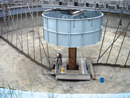
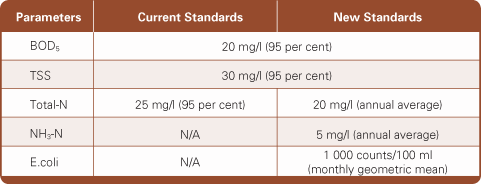
Upgrading Works in Tai Po STW Tai Po STW currently serves a population of over 260 000 and treats about 90 000 m3 of wastewater per day. To cope with the development of Tai Po, the Tai Po STW Stage 5 Phase 1 works that commenced in May 2005 together with the new UV disinfection facilities under construction (Stage 5 Phase 2A works) would be completed in 2009. By then, the treatment capacity of Tai Po STW will be increased to 100 000 m3 per day. In addition, further expansion of the treatment capacity of Tai Po STW to 120 000 m3 per day would be made under the Stage 5 Phase 2B works which is under detailed design to serve a population of 290 000. The work is expected to be completed in late 2013. Tai Po STW has in the upgrading design adopted an advanced treatment process - the Modified Ludzack-Ettinger (MLE) treatment process, to remove nitrogen. The aeration tank is configured into an anoxic zone, a subsequent aerobic zone and an internal recycle system such that nitrate/nitrite can be denitrified into nitrogen in the anoxic zone. Also, the advanced 3-dimensional computational fluid dynamics (CFD) computer modeling techniques are applied in the design of final clarifiers. Based on the modeling results, an innovative “Multi-layer Energy Dissipating Inlet Column” is developed as the inlet design to final clarifiers.
Upon completion of all the upgrading works, the new effluent discharge standards of Tai Po STW will be as follows:
|
||||||||||||||||||||||||||||||||||||||
Ultraviolet Disinfection System at Sha Tin STW Treated effluent from the Sha Tin STW is discharged via a sewage tunnel and the Kai Tak Nullah into the Victoria Harbour. To further improve the water quality of Victoria Harbour, an Ultraviolet (UV) disinfection system is being installed at the Sha Tin STW to provide disinfection to the treated effluent so as to meet the new discharge standard of EPD. The works commenced in mid-2008 and is targeted to put into service by end-2009. The design flow rate of the UV system is 340 000 m3 per day and the treated effluent of the UV system will meet the following standard:
UV technology provides a proven, accepted and environmentally friendly method of disinfecting treated effluent. UV light is generated in special UV lamps. It changes the DNA of microorganisms in the wastewater and interrupts its cell division, consequently it can no longer reproduce itself and thus loses its pathogenic effect. |
||||||||||||||||||||||||||||||||||||||
Computerized Activated Sludge Modelling To keep in pace with the worldwide trend in using the computer modelling technology for the design and operation of sewage treatment processes, a computer model of the activated sludge sewage treatment process of Shek Wu Hui STW was built in November 2007 after a series of tests on the sewage characteristics. Further implementation of computer models in other major secondary STW of DSD is in progress. It is targeted to complete the computer models of Sha Tin STW and the HATS Stage 2B project in mid 2008. With the implementation of computer models, more useful data and information of the sewage treatment processes in the STWs of DSD can be made available. The performance with respect to the effluent quality can be predicted. This can enhance the effectiveness in the design and operation of the STWs managed by DSD. |
||||||||||||||||||||||||||||||||||||||
|