Environmental design is one of the key approaches that DSD adopted for sustainable development. This chapter presents two examples of our recent works to illustrate how environmental improvement could be achieved at the design stage of our projects. The first case is on flood prevention, and the second one is about odour control in sewage treatment. |
||||||||||
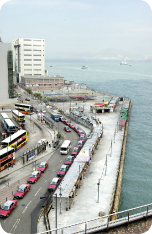
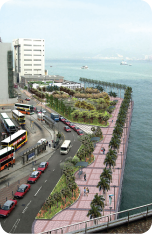
Environmental Design of the Sheung Wan Stormwater Pumping Station The area in the vicinity of Wing Lok Street, Sheung Wan is low-lying and stormwater can back-flow causing flooding under extremely high tide. Flooding is common during heavy rain coupled with high tides. To alleviate the flooding problem, DSD has commenced construction of a stormwater pumping station at the waterfront in Sheung Wan to store and pump the runoff collected from the low-lying areas to the harbour. Design Overview The Sheung Wan Stormwater Pumping Station occupies an area of about 2 600 m2 on a waterfront site abutting Chung Kong Road. The pump house is the only above-ground structure comprising a 6 m high single-storey building with two levels of basement. The roof of this building will be garnished as a roof garden which will help to lower the temperature inside the plant room below. Sky windows will be installed at the roof level to introduce natural light into the interior of the pumping station. It is expected that the incoming flows during dry weather from the upstream areas would be polluted. Therefore dry weather flow pumps will be provided inside the underground storage tank to pump polluted dry weather flows to a new sewer for conveyance to the sewage screening plant for treatment before discharging to the harbour. For odour control, a deodorizer with air suction points at the mechanical screens and the low flow chamber will be installed to prevent odour from releasing to the adjacent park. Some of the energy saving features adopted in the electrical and mechanical design are summarized below: |
||||||||||
|
||||||||||
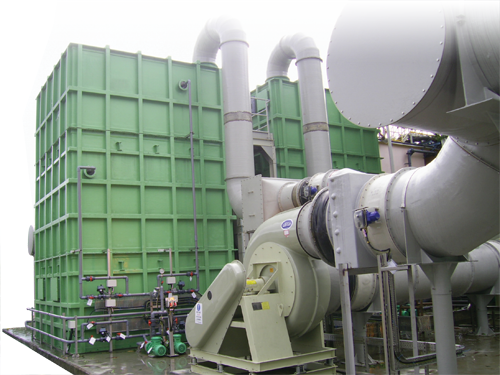
Environmental Design of a Deodorising System at Sha Tin STW Odour arising from the Sha Tin STW has become a growing concern when residential estates are developed in its vicinity. The closest residential development, Kam Tai Court in Ma On Shan, was completed in 2000. It has a population of more than 10 000 and is located immediately on the opposite bank of Shing Mun River. To properly manage the odour issue at the Sha Tin STW, DSD has identified that the major odour sources are located at the inlet works, primary sedimentation tanks, and sludge treatment facilities. The major odour sources would be covered and the air would be treated to remove the odour. |
||||||||||
|