Guidelines on Environmental Considerations for River Channel Design
To address the ever increasing demand for more eco-friendly flood control works and to protect our precious natural rivers and streams from damage as that inflicted upon Tung Chung River and Sha Kok Mei Stream, government has issued important technical circulars and guidelines to guard against future devastation of rivers from construction works and to set out good practices. It is recognized that river management has to balance between flood control, functional performance of the channel, land development needs and giving living space for establishment of plant and animal communities. Flood control schemes in the countryside have now included considerations on vegetated river banks, in-channel ponds, reed-beds and purposely-built lowland freshwater marshes.
The Strategy
The strategy is to Avoid, Minimize and Compensate when devising river training works. This means that impacts are to be avoided at the onset, followed by adopting options of least impact and compensation for significant residual impact.
Examples of possible engineering solutions under each approach include :
 |
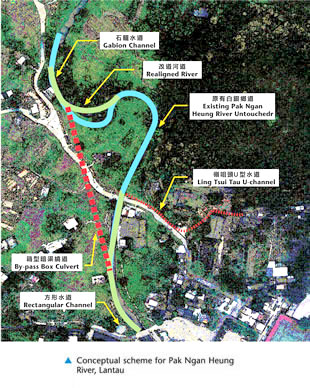
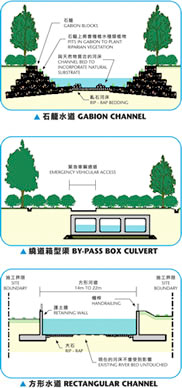
Avoidance - Use of distant flood banks, multi-stage channels, relief or bypass channels to conserve the natural streams |
|
Minimization - Use of appropriate methods of bank stabilization, clearing and removal of obstructions, enlargement of channel by |
| widening or deepening, realignment/straightening, artificial lining to minimize impacts caused to the natural streams | |
|
Compensation - Creating wetland habitats ; setting aside meanders as wildlife refuge |
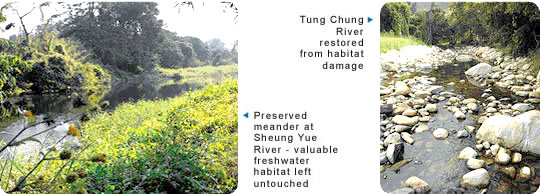 |
Beyond the selected option, more thoughts will be given to enhance eco-channel by restoring naturalness without entailing excessive cost or compromising the integrity and functions of the flood relief works. This neo-natural river reconstruction concept will attempt to meet hydrological needs while producing bankside and in-stream conditions closest to nature for animals and plants to gain foothold and, enhancing landscape quality of the river channel.
 Enlarge Enlarge |
 Enlarge Enlarge |
Engaging Ideas from Stakeholders
Land drainage is a highly important element of countryside management. During preparation of the guidelines on environmental considerations for river channel design, DSD was mindful to listen to the aspiration of naturalists and academics as well as rural residents. We held a "Workshop on Protection of Natural Streams/Rivers from Adverse Impacts Arising from Construction Works" on 4th May 2005. The draft guidelines as well as eco-design features of Yuen Long Bypass Floodway and San Tin West Drainage Channel were introduced to representatives from six green groups and three universities, followed by a site visit to the created wetland of Yuen Long Bypass Floodway. Constructive comments from the workshop participants have since been received and incorporated into the guidelines as far as practicable. The synergy of conservationists, academics and engineers proved to be very valuable.
Looking Ahead
The goal that we strive for is clear. It is a river environment that accommodates the natural dynamics of water flows while mitigating flood hazard upon life and properties, sustaining naturalness, supporting diverse living assemblages, providing ecosystem linkage and wildlife corridors, and offering the venue for learning, amenity and visitation of our natural heritage.
The drafting of the guideline and the collective awareness of the priority to sustain the physical and ecological functions of our water courses points to a positive direction in creating a better quality of life in Hong Kong.
Greening Sewage Treatment and Pumping Facilities
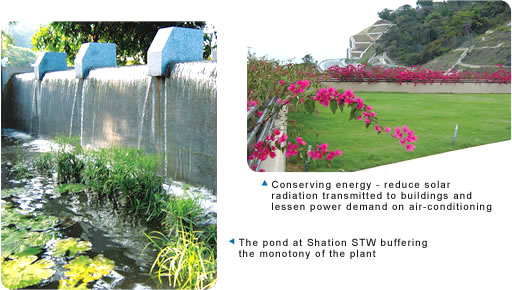
Recognizing that green landscape enhances the quality of life, DSD has been conscious to apply greening effort to soften sewage treatment works, sewage and flood pumping facilities which could be visually sensitive in their neighbourhood. The greening helps reduce visual monotony, enrich local biodiversity and improve microclimate such as providing shades, absorbing heat and reducing flying dust. Trees and flowers also provide a sense of seasonal change and increase aesthetic quality.
Landscape treatment of the periphery could range from placing flower bed at the perimeter wall, allowing for a planting strip along the boundary to serve as a landscape buffer, to building a podium garden that is accessible by the public.
Landscaping within the sewage treatment works and sewage pumping stations elevates the ratio of green cover in the district. It also harmonises the shapes, textures and colours of such utility service architecture. Greenery mediates concrete buildings, tanks, pump rooms, exhaust pipes, walls, and open area. Notable examples can be found in Stonecutters Island STW, Shatin STW and Cyberport STW.
 |
| While landscape design is introduced to new works, DSD is continuously pursuing more landscaping measures in existing sewage treatment works and sewage pumping stations. We strongly believe green effort to make-over the plants will not only improve environment but also give confidence to the community that we always have regard to the neighbourhood and will maintain and enhance the sites in the best possible way. | 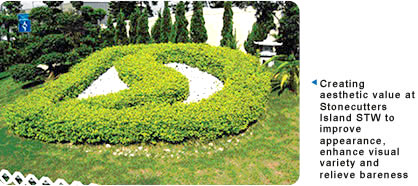 |